


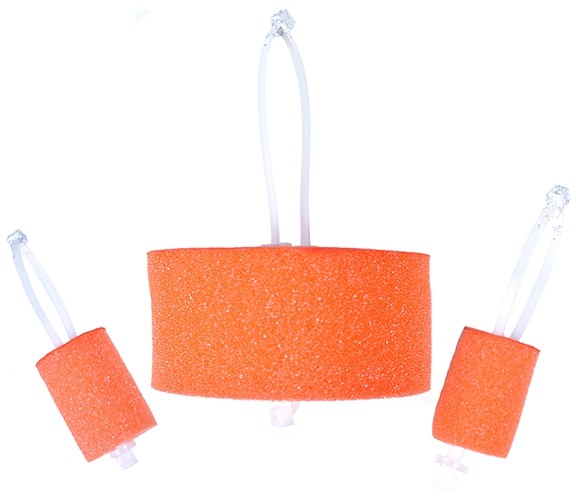


PL4 4.25" FME Sponges 15/pkg
4.25" FME Sponges 15/pkg
- Quick installation & removal
- Low Halogen and Heavy Metals
- Conforms to uncommon dimensions & shapes
- Withstands flange sandblasting
- Fail safe handles
- Remain in position indefinitely
- Custom made to fit L.P. & H.P. extraction ports, tube & seal openings
- Sponges can be withdrawn and inserted through manhole openings
- Doughnut sponges available for turbine oil applications
- Material is non-reactive to oil & non-flamable facing is available
- Custom designs available, product is reusable
4.25" FME Safe-T-Sponges 15/pkg
FEATURES
- Low Halogen and Heavy Metals
- Withstands flange sandblasting
- Custom made to fit L.P. & H.P. extraction ports, tube & seal openings
- Fail safe handles
PL4 4.25-Inch Laminated FME Sponges — 15/Pack
Create visible, retrievable foreign material exclusion barriers in boiler tubes, piping and equipment openings during maintenance and repair work. PL4 is a laminated, compressible FME sponge with a nominal 4.25-inch (107 mm) outside diameter, supplied 15 sponges per package.
Each sponge includes an adjustable retrieval loop. The coated loop tip contains x-ray-visible material that can assist with locating retained loop-tip material in boiler-tube applications. Select, install, tether, inspect and account for every sponge under the facility’s approved FME program.
Key Features
● 4.25-inch (107 mm) nominal outside diameter
● 15 sponges per package
● Laminated small-diameter construction
● Compressible fit for boiler tubes, piping and equipment openings
● Adjustable retrieval loop for controlled insertion and removal
● Coated loop tip containing x-ray-visible material
● Low levels of halogens and heavy metals
● Suitable for properly controlled flange-sandblasting applications
● Quick insertion and retrieval when the correct size is selected
● Reusable only when permitted by the site’s FME program and the sponge remains clean, accounted for and undamaged
● Custom sizes and configurations are available for nonstandard applications
Important Fit Information
The 4.25-inch dimension is the sponge’s nominal outside diameter; it is not automatically the correct choice for every 4.25-inch opening.
Select a sponge that fits tightly enough to remain in position while still allowing easy, controlled insertion and retrieval. Measure the actual clear opening and consider its shape, surface condition and orientation before use.
Do not force the sponge into a sharp, damaged or excessively tight opening. For an unusual diameter, shape, surface condition or application, contact Energy Safety Supply before use. Custom FME barriers are available for many nonstandard openings.
How to Use the PL4 FME Sponge
These instructions summarize current product-use guidance for small-diameter PL sponges. The facility’s approved FME procedure, work package and responsible FME or quality personnel control the application.
- Assign and Record Each Sponge
Before installation, assign each sponge to a specific opening under the site’s FME tracking system. Record the product identification, installation location and any job-specific identification required by the work package.
Account for all 15 sponges received in the package, including unused, installed, rejected and removed sponges, as required by the site’s FME program.
- Inspect Before Installation
Inspect the entire sponge, including the foam body, laminate, adjustable retrieval loop and coated loop tip. Do not use a sponge that is worn, cut, torn, frayed, contaminated, distorted or otherwise damaged. Account for and replace rejected sponges under the site’s FME process.
- Confirm the Size and Application
Measure the actual clear opening. Verify that the sponge fits tightly enough to remain in position while still allowing easy insertion and retrieval.
Confirm that the opening is free from sharp edges or surfaces that could cut or abrade the sponge or damage the laminate. Do not use PL4 as a pressure plug, mechanical isolation device, load-bearing surface or substitute for an engineered barrier.
- Orient the Sponge Correctly
Place the sponge into the tube or opening with the laminate side and coated retrieval-loop tip facing up toward the opening. Keep the adjustable loop centered and accessible for controlled removal.
- Position It Below the Work
When used below machining or milling work, position the sponge beneath the tool with the laminate and retrieval loop facing up. Confirm that the sponge remains seated and that the loop cannot contact or become entangled with rotating or moving equipment.
- Apply the Required Tether or Lanyard
Attach and control a lanyard as required by the site’s FME program and applicable industry standards. Lanyards are recommended for PL sponges where practical.
For a vertical-down application, tether the retrieval loop or handle. Keep the tether identified, controlled and clear of moving equipment, hot work and entanglement hazards.
- Protect and Inspect During Use
Inspect the sponge during the work at the frequency required by the approved procedure. Protect it from welding slag, flame, grinding sparks, ignition sources and sharp surfaces.
The current general instructions state a maximum recommended temperature of 185°F (80°C) for PL and NPL sponges in sizes 1 through 4. PL4 is not a high-temperature configuration. Contact Energy Safety Supply before elevated-temperature use.
Do not step on the sponge or place tools, equipment or other loads on it.
- Control Chemical and Fluid Exposure
● Do not expose the sponge to acetone or alcohol-based solvents.
● Do not expose this laminated sponge to hydraulic oil or other oils. Oil can damage the laminate bond.
● Incidental amounts of water-based cutting fluid are acceptable under the general instructions, but the sponge must remain serviceable and pass inspection.
● Do not immerse the sponge or expose it continuously to water or other fluids.
● Isolated exposure to a small amount of water is acceptable, but the sponge must still pass inspection before continued use.
- Remove Debris Before Retraction
Vacuum or otherwise remove accumulated debris using the approved work procedure before retracting the sponge. This reduces the chance of releasing debris into the protected opening during removal.
- Retrieve, Account and Inspect
Remove the sponge using its retrieval loop or controlled tether without damaging the opening or sponge. Immediately reconcile it with the FME log.
Inspect the sponge after removal. Replace it if the foam, laminate, loop or coated tip is worn, cut, torn, frayed, contaminated, distorted or otherwise damaged. Store acceptable sponges in a clean area away from contaminants.
Use Limitations and Warnings
● Follow the facility’s approved FME program, work package and tracking requirements.
● Account for all 15 sponges supplied in the package.
● Inspect each sponge, laminate, loop and coated tip before, during and after use.
● Use only where a tight but readily retrievable fit can be achieved.
● Install with the laminate side and coated retrieval-loop tip facing up.
● Keep the retrieval loop accessible and centered where practical.
● Tether the retrieval loop or handle in a vertical-down application.
● Do not cut, trim or otherwise modify the sponge. Request a different size or custom configuration instead.
● Do not use against sharp edges or abrasive surfaces that could damage the foam or laminate.
● Protect sponges from welding slag, flames, grinding sparks and ignition sources.
● Do not exceed the applicable temperature rating or assume PL4 is a high-temperature product.
● Do not expose the sponge to acetone or alcohol-based solvents.
● Do not expose the laminated sponge to hydraulic oil or other oils.
● Do not immerse the sponge or expose it continuously to water or other fluids.
● Do not step on the sponge or place loads on it.
● Do not use the sponge as a pressure seal, mechanical isolation device, walking surface or structural support.
● Keep the retrieval loop and tether clear of moving machinery and entanglement hazards.
● Remove, account for and replace any sponge that becomes damaged or cannot be positively identified.
From the ESS Team
The most important parts of selecting and using these 4.25-inch FME sponges are choosing a tight but readily retrievable fit, installing each sponge with the laminate and coated loop tip facing up, keeping the retrieval loop accessible and positively accounting for every sponge after removal.
PL4 is a laminated small-diameter sponge. It does not use the 3/8-inch compression rule that applies to PL and L-PL sponges measuring 5 inches and larger.
The coated loop tip contains x-ray-visible material that may assist with locating retained loop-tip material in a boiler tube. This feature does not replace installation records, tethering or positive material accountability.
This package contains 15 sponges. Account for the full package quantity under your site’s approved inventory and tracking process, including sponges that remain unused.
Use your site’s approved tracking and tethering requirements. For a vertical-down application, tether the retrieval loop or handle. Inspect each sponge before, during and after use, vacuum accumulated debris before removal and immediately reconcile each sponge with the FME log.
One limitation that matters: PL4 is laminated and should not be exposed to hydraulic oil or other oils because oil can damage the laminate bond.
If the work involves oil, chemicals, elevated temperature, sharp edges, continuous moisture or an unusual opening, contact ESS before selecting the product.
Need another diameter or a custom shape? Use our live chat or request a quote, and include the opening dimensions, shape, orientation, work conditions and application requirements.
Frequently Asked Questions
Is PL4 intended for every opening with a 4.25-inch inside diameter?
Not automatically. PL4 has a nominal 4.25-inch outside diameter. The selected sponge should fit tightly enough to remain in position while still allowing easy, controlled insertion and retrieval. Measure the actual opening and follow the site’s approved selection process.
How many PL4 sponges are included?
Each package contains 15 PL4 sponges.
Is PL4 laminated?
Yes. Current product instructions state that PL1 through PL4 and NPL1 through NPL4 are laminated small-diameter sponges.
Which side faces up?
Install PL4 with the laminate side and coated retrieval-loop tip facing up toward the opening. Keep the loop centered and accessible for controlled removal.
What is the difference between PL4 and NPL4?
PL4 is the base small-diameter configuration. NPL4 is the separate nuclear-specific configuration and includes NPL-specific batch-control provisions. Do not treat the two SKUs as interchangeable; use the product approved by the facility’s FME and quality requirements.
Is the entire PL4 sponge x-ray visible?
The current instructions specifically identify x-ray-visible material in the coated loop tip. Do not assume the entire sponge is x-ray visible. Positive tracking, tethering and retrieval remain required.
Does the sponge need a tether?
Use a lanyard or tether as required by the site’s FME program and applicable industry standards. Lanyards are recommended for PL sponges where practical. For a vertical-down application, tether the retrieval loop or handle.
Can PL4 be used around hydraulic oil or other oils?
No. PL4 is laminated, and current instructions state that laminated sponges should not be exposed to hydraulic oil or other oils because the laminate bond may be damaged.
Can the sponge be cut to fit a smaller or irregular opening?
No. Cutting or modifying the sponge is not recommended. Contact ESS for a different size or custom configuration.
Can PL4 be reused?
Only when the facility’s FME program permits reuse and the sponge remains clean, positively accounted for and undamaged after inspection. Replace a sponge with damaged foam, laminate, retrieval loop or coated tip.
Is PL4 a high-temperature sponge?
No. The current general instructions state a maximum recommended temperature of 185°F (80°C) for PL and NPL sponges in sizes 1 through 4. Contact ESS for an application-specific high-temperature configuration.
How is PL4 sold?
PL4 is sold as a package of 15 sponges.
What information should I provide when requesting help?
Provide the opening’s actual dimensions and shape, installation orientation, temperature, fluid and chemical exposure, nearby machining or hot-work conditions, required traceability and tethering requirements.
Documentation
Technical, chemical-control, traceability and available conformity documentation can be requested through Energy Safety Supply. Documents are provided unaltered when manufacturer identification or other traceability information is required.